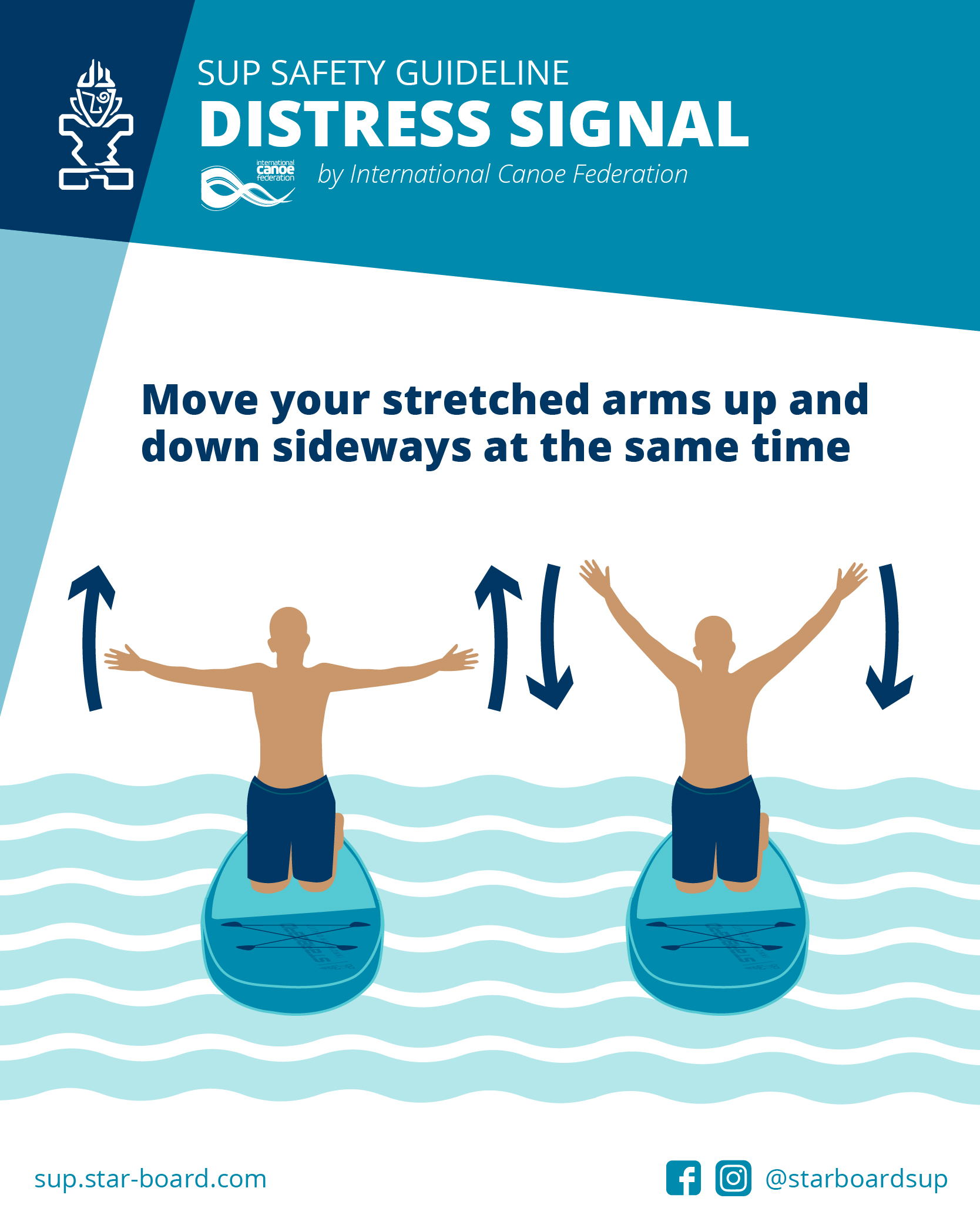

The picture explains a signal made with your arms. When you're actually out on the water, bring a buoyancy aid that fits you and a way to call for help, and if you need emergency rescue in Korea, call 119.
On the water, your voice doesn't always carry. That's why you need both a visible signal and a way to call for help directly. It's just one short picture, but it's worth learning in advance with the people you paddle with.
01. Raise and lower both arms together
The picture shows a distress signal where you stretch both arms out to the sides and move them up and down together. Remember to tell it apart from a casual wave with one arm.
The person in the picture is kneeling on the board. Rather than forcing yourself to stand up to get help, signal as best you can from a position where you can keep your balance.
02. Think about signaling and calling together
You can't count on an arm signal alone being noticed or bringing rescuers. Keep a way to call, such as a phone, on your body and waterproofed, so you can reach it when you're in trouble.
If you need emergency rescue in Korea, call 119 and say you need help on the water. Explain your location, how many people are involved and what's happening, and follow the operator's instructions. If you only know the name of the place, mentioning your launch point and nearby landmarks helps.
03. Stay with your board and save your energy
When you need help, stay with your board to keep yourself supported and focus on making your location known. It's better not to abandon the board and push yourself to swim a long way to sort it out.
This picture is a diagram of the arm movement for the signal. When you actually go paddling, have a buoyancy aid that fits you and a leash suited to the water, and check that everyone is ready with your companions before you set out.
04. If someone else is signaling
If you see someone repeatedly asking for help, don't dismiss it as a casual wave; check the situation from a safe position and call for rescue. Jumping into the water without rescue experience or equipment can lead to another danger.
Before you set out, tell your companions once, “If I'm in trouble, I'll use this signal.” If you also agree on how to reach each other and when you'll be back, you'll notice sooner if something actually goes wrong.
Sources and scope
The artwork is Starboard's original Distress Signal infographic, keeping the two-arm up-and-down signal and the ICF source logo; the explanation is Starboard Korea's commentary. Guidance on actually wearing a PFD, carrying a way to call and staying with your board was added from RNLI materials. The 119 number in Korea and the joint response with the Korea Coast Guard were checked against official Korea Coast Guard materials, and the UK's 999 number was not carried over into the guidance for Korea. We do not encourage bystanders to attempt risky direct rescues.
- Distress signal_V3-01.jpg ↗
- RNLI SUP safety advice ↗
- RNLI: staying with your board and calling for help ↗
- Korea Coast Guard: joint response to emergency calls ↗
The illustration is Starboard's original artwork; the explanation is Starboard Korea's editorial guide, translated into English here. Sources checked: 2026-09-08.