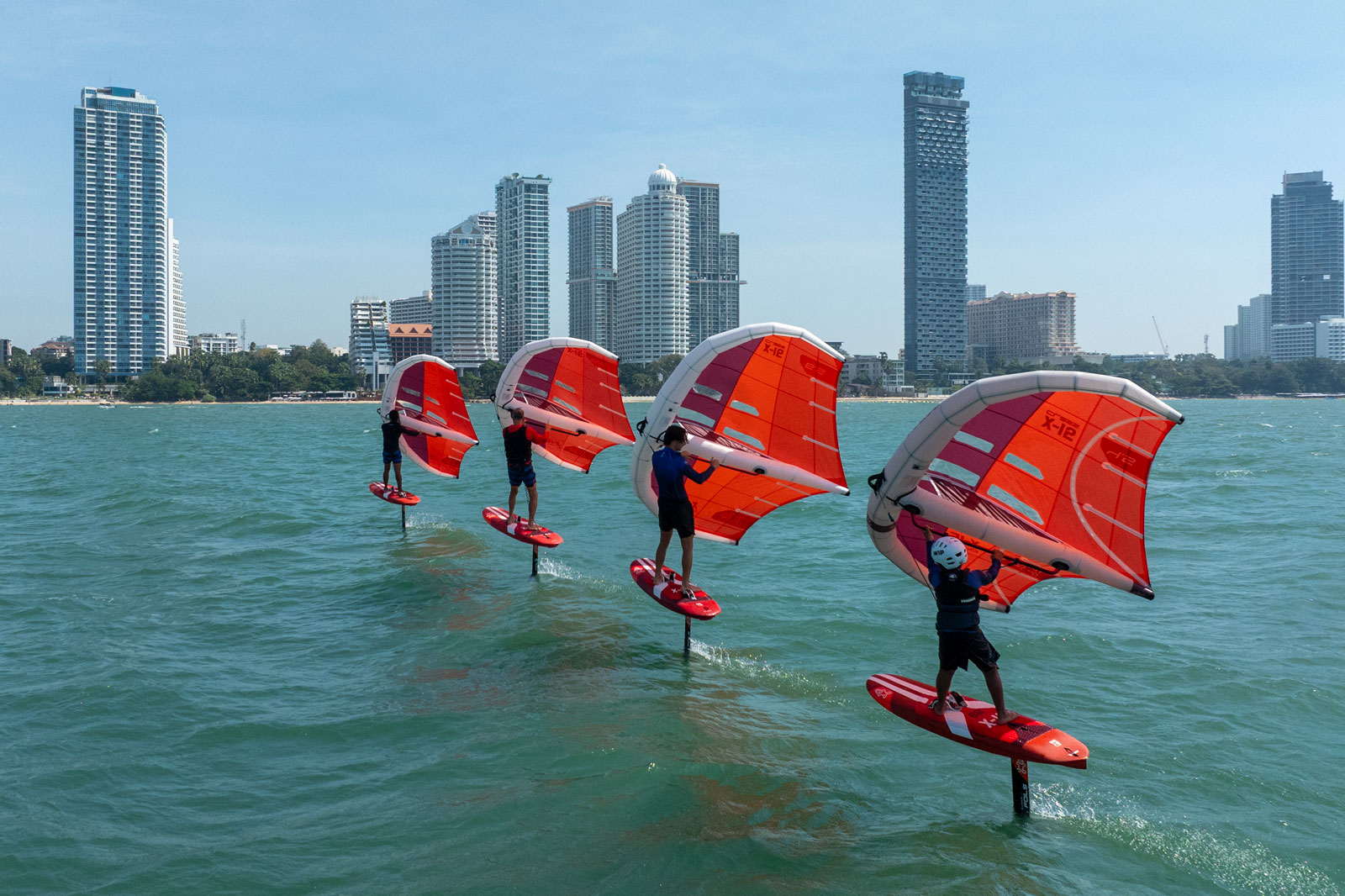
X-15 began where an old idea met new possibilities. Follow Svein's 2023 letter through the journey from FreeWing to a one-design wingfoil class.
A tribute to Jim Drake. Photo: X-15 Class · Mission X-15: A Letter from Svein
01
2012, · The FreeWing Beginning
It started with an inflatable wing.
The Airush and Starboard development teams created FreeWing following extensive discussions between Clinton Filen and Jim Drake. Drake, a co-inventor of windsurfing, had already introduced a rigid wing in 1982, but combining it with a foil was not an option at the time. Svein considered a conventional windsurfing rig better suited to a board with fins, and the project paused.
02
Foils Opened Up New Possibilities
A foil beneath the wing changed the story.
Svein reflects that foils transformed wing sports. The next step was to bring that potential to racing. Some felt it was too early, but riders wanted to test their skills on equal equipment. X-15 began as a one-design class in response to that ambition.
03
The Gratitude Behind the X-15, Name
The racing class is named in tribute to Jim Drake.
Drake also helped design the X-15 aircraft. Svein honoured that contribution in the class name. The project brought together Olympic foil and board designers Tiesda You and Remi Vila, America's Cup designer Martin Fischer, aerospace engineer John Lewis, Clinton Filen and Svein. Their different backgrounds converged in a new form of racing on the water.
FLIGHT FOR ALL
Equal equipment, your own skill.
2025.11World Sailing Class Recognition
X-15 is a 1-person one-design wingfoil racing class using wings, boards and foils that comply with class rules. Within shared equipment limits, riders compete through technique, reading the wind and race strategy.
Starboard launched the X-15 project drawing on its experience in windsurfing and foil development. The class name honours Jim Drake, co-inventor of windsurfing and a contributor to the X-15 aircraft programme.
Racing where young people, women and riders from new regions can grow together. X-15 aims to connect international competition with local clubs.
Equal equipment does not mean an identical race. Start timing, course decisions and stable foiling all come together on the water.
2025 Alacati X-15 Open · Photo: X-15 Class
Prepare to set off
Learn the event's starting procedures and signals. Equipment inspection and water safety preparations are part of racing too.
Read the Wind and Course
Check the course and marks, then choose your route while reading the wind and other riders' movements.
Take Experience into the Next Race
Reflect on technique and decisions before your next start. Check each event's instructions for the race format and scoring.
Class rules define equipment and eligibility. For courses, starts and race management, also read the event's Notice of Race (NoR), Sailing Instructions (SI) and applicable racing rules.
ONE WING. ONE BOARD. ONE FOIL SYSTEM.
Three Elements of Racing
Check your division and its rules before selecting equipment.
01 / WING
X-15 Class Wing
Permitted wing areas differ by division. Identify your age category and entry division before checking equipment.
Check equipment generations and serial numbers against your division and the latest class rules. The table below summarises wing areas and mast requirements. Contact us to confirm catalogue configurations, stock and availability in Korea.
Effective 2026-1-1 · Approved rules. A summary of the key requirements to start with.
One rider, class-compliant equipment
All divisions use the X-15 Lite Tech 82L board. Wing areas and foil mast requirements vary by division.
Equipment Registered for One Event
Register 1 board, 1 wings, 1 foil system and up to 3 front wings (1 of each size). Equipment lost or accidentally damaged beyond repair may be replaced with approval from the event's technical committee.
Wing areas and masts specified for each division
Division
Age · Category
Wing area (m²)
Foil mast
U13
Under 13 years old
4.5
Aluminium 100 cm
U15
Under 15 years old
5.0 · 4.0
Aluminium 100 cm
U17
Under 17 years old
5.5 · 4.0
C600 Carbon 100 cm
U19
Under 19 years old
6.0 · 4.5
C600 Carbon 100 cm
Senior Women
Senior Women
6.0 · 4.5
C600 Carbon 100 cm
Senior Men
Senior Men
6.5 · 5.0
C600 Carbon 100 cm
U13, U15, U17 and U19 ages are measured as of 12/31 in the competition year. The areas shown are permitted options under the rules, not a requirement to register two wings together. Carbon masts use Deep Tuttle. References: C.2.3 Age ↗, E.1.1 Masts ↗, G.1.1 Wings ↗, C.6.2 Equipment registration ↗.
How do I identify the front wing and equipment generation?
Rule E.1.1 lists front wings 560, 820, 880 and 1200. Appendix A identifies 820 as existing MkII equipment and lists UCS front wings as 560, 880 and 1200. The shared tail wing is 200, and the fuselage is 69 cm.
World and European championships, and international events specified in the rules, use Appendix A's latest generation and serial-number requirements. Compare the event documents with the generation and serial numbers on your equipment.
Wear a helmet and impact vest meeting the rules, and carry a whistle. Check the certification standards and any additional event requirements rather than relying on the product name alone.
Helmets must meet EN1385, EN1077, EN966, ASTM2040, Snell S98 or an equivalent standard listed in the rules, as well as requirements for a highly visible outer surface. Impact vests must meet ISO12402-5, USCG Type III, AS4758 Level50 or an equivalent standard.
Where can I check membership and entry requirements?
National, world and continental championship entrants must belong to their national class association, or to the X-15 class association if no national association exists. Check the official event page for divisions, registration procedures and additional requirements.
This guide summarises key points from the supplied class rules effective 2026-1-1. For competition, also consult the English class rules, Equipment Rules of Sailing (ERS), Racing Rules of Sailing (RRS), event Notice of Race (NoR) and Sailing Instructions (SI). The English original takes precedence if interpretations differ. Check for revisions at Official class website ↗for details.