
Self rescue back to shore
Signaling for help

Read the words in the picture
Self rescue back to shore
- Lesson Three
- Getting on the Water
- Now we have gotten to grips with the wing basics, it is time to try out our new skills on the water!
- Self Rescue
- Sometimes we can get in sticky situations on the water and it is important to know how to get yourself out of trouble! Self rescue techniques can be used to help get you back to shore if the wind has died or changed direction, your equipment has broken, or you are simply having trouble winging back.
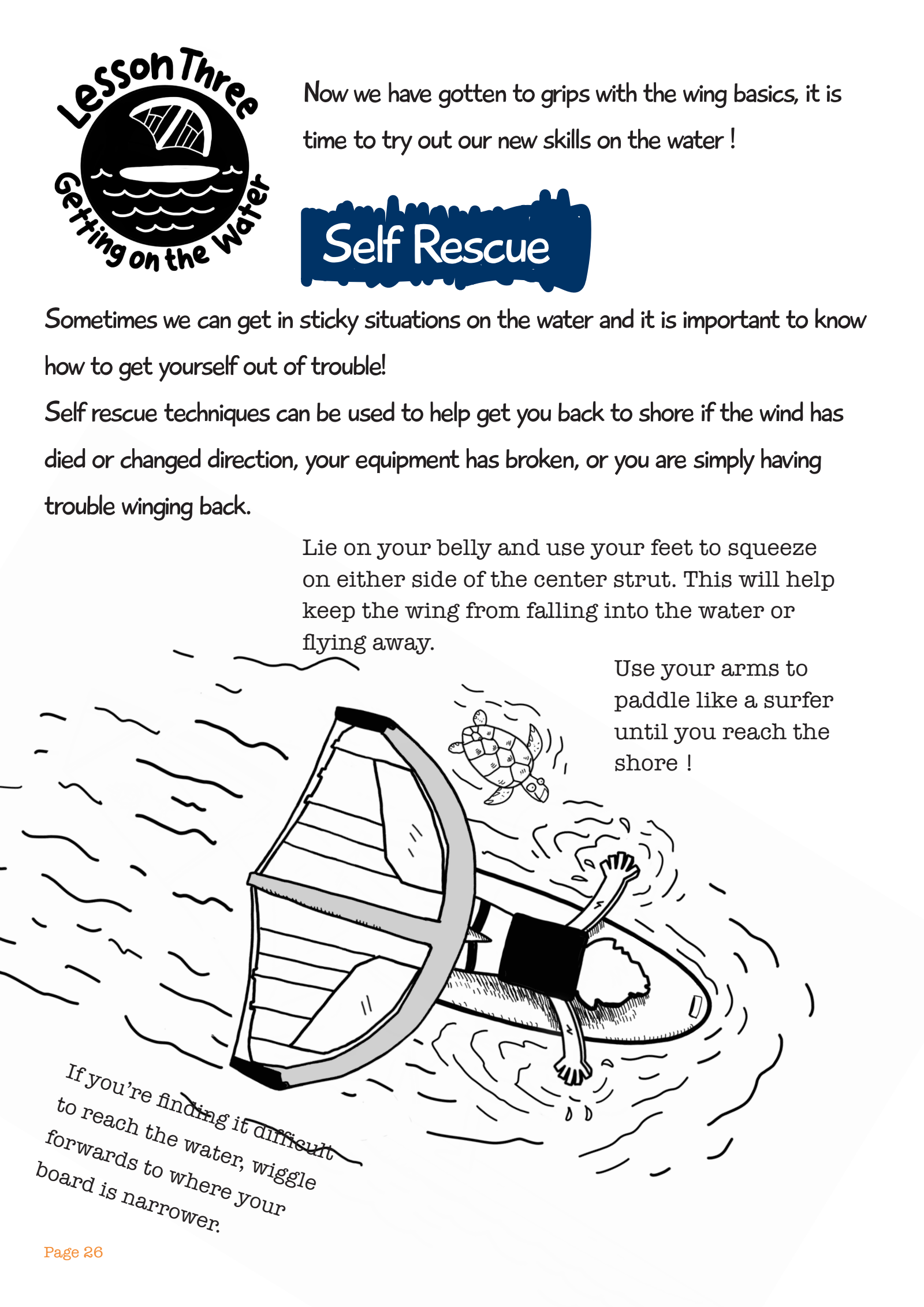
- Lie on your belly and use your feet to squeeze on either side of the center strut. This will help keep the wing from falling into the water or flying away.
- Use your arms to paddle like a surfer until you reach the shore!
- If you're finding it difficult to reach the water, wiggle forwards to where your board is narrower.
Signaling for help
- Attracting Attention
- Being able to rescue yourself is super important, but what if you aren't able to? If you need help, it is important to be able to let someone know straight away. Whether that be your parents on the beach, a lifeguard or someone on the water.
- Sit on your board facing the person or people whose attention you want to attract.
- Slowly raise and lower both arms, just like TIKI is in the pictures above. Keep waving like this until you can see someone is coming to help.
- Use a whistle if you have one, or shout if there are people near enough to hear.
- The most important thing is to remain calm and to stay with your gear.
- It's important to use the two arm wave so that people know you are in trouble and not just saying hello!
- Hello!
Letting people know quickly that you're in trouble is a skill to learn too
If the wind drops or changes direction while you're winging, it can be hard to get back the way you were just moving. Sometimes your gear breaks, or steering the wing just isn't working. WingKids explains that you should think about these situations ahead of time and learn self rescue and how to ask for help.
Self rescue is a skill you learn so you can get yourself back to a safe place when you're in trouble on the water. The workbook shows an example of lying on the board, keeping the wing steady and paddling with your arms toward the shore. But that doesn't mean this one method solves every situation. Learn it with real gear from an instructor, and be able to let people know when it's hard to get back on your own.
On the next page, TIKI is slowly raising and lowering both arms. This is a help signal, different from a friendly one-hand wave hello. It's better to look at the signal and practice it with a grown-up before your lesson than to try to remember it for the first time when things get urgent on the water. This time, read the order and meaning of the pictures on land.
Let's try it together
Talk about when you might need help
The situations to look at first are when the wind dies or changes direction, when your gear breaks, and when it's hard to get back with your wing. Looking at the pictures, think about what you could add to “It's not working” to explain the situation more clearly. Check with a grown-up that the first thing to do is let people know about the problem in the way you agreed with your instructor before the lesson, instead of trying to fix it alone for a long time.
Understand the purpose of the self rescue picture
The person in the picture is lying on their belly on the board. In this example, they hold either side of the center strut with their feet so the wing doesn't fall in the water or fly away, and paddle with their arms to move. The picture also shows that if it's hard to reach the water, you can move a little forward to where the board is narrower. Here, the goal is to understand what the position is for. Learn how to actually use it from an instructor, in a way that fits your gear and your body.
Learn the two-arm signal on land
Read along as TIKI faces someone and slowly raises and lowers both arms. On the water, this is sitting on the board and signaling to a grown-up on the beach, a lifeguard or someone nearby. Keep signaling until you can see someone is coming to help. Explain to your family how it's different from a one-hand wave hello, and check together what your real lesson's plan is for asking for help.
Remember sound, gear and staying calm together
If you have a whistle, use it, and if people are close enough to hear, you can shout too. The workbook also stresses staying calm and staying with your gear. With a grown-up, go over ahead of time who you would ask for help at your lesson spot. This step isn't about creating a dangerous situation to practice. It's about getting ready by listening to the explanation and knowing how to get help before you head out.
Let’s talk
What do you think?
- How can you tell a one-hand wave hello apart from a two-arm call for help?
- In your lessons, who should you tell, and how, when you're in trouble?
Where the pictures and activities come from
WingKids workbook p. 26 ↗ · p. 27 ↗
The pictures are pages from the original workbook. The steps and questions below are Starboard Korea’s notes to help families use them together.
Save the original workbook ↓