
The Powered Position
Read the words in the picture
The Powered Position
- The Powered Position
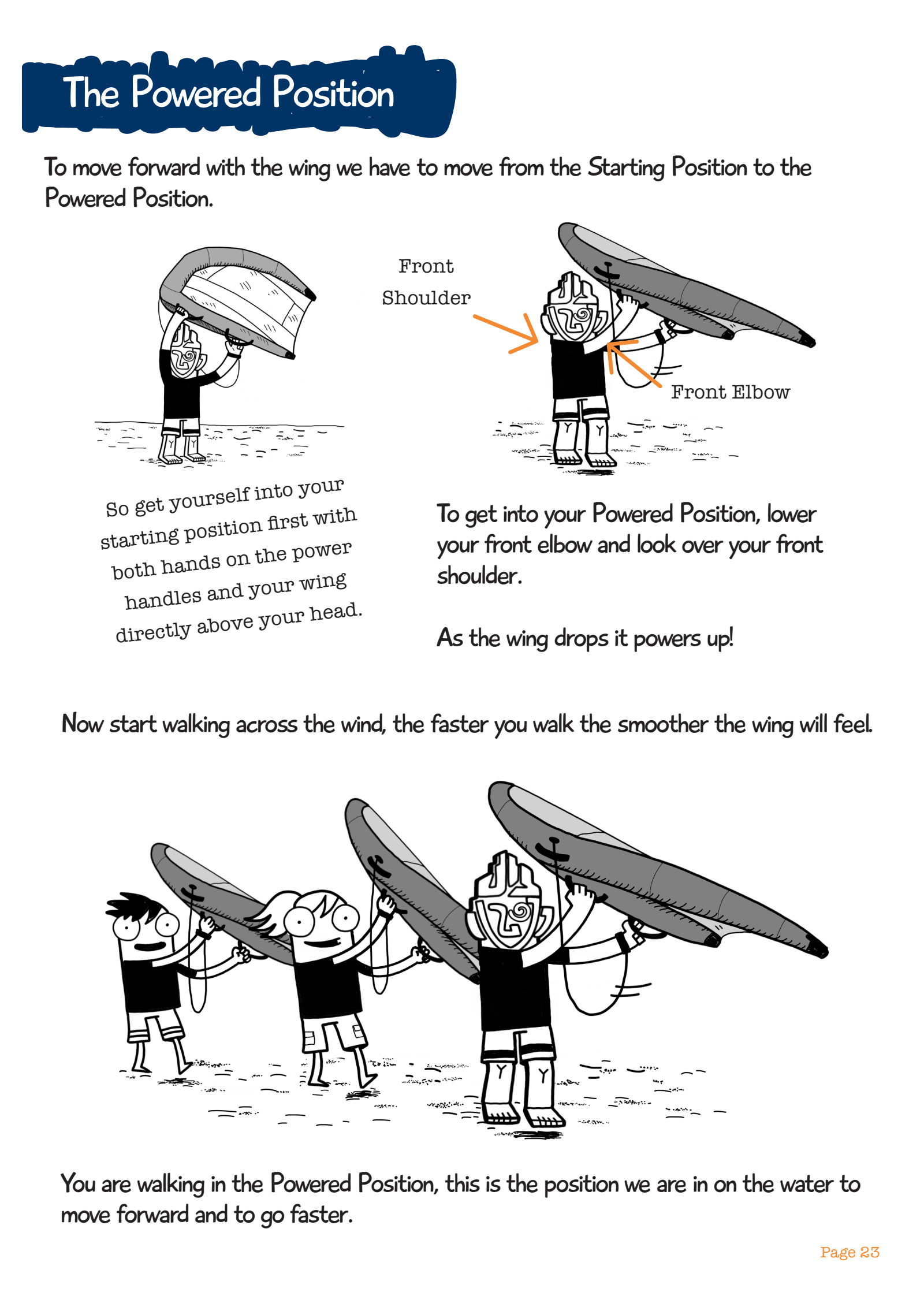
- To move forward with the wing we have to move from the Starting Position to the Powered Position.
- So get yourself into your starting position first with both hands on the power handles and your wing directly above your head.
- Front Shoulder
- Front Elbow
- To get into your Powered Position, lower your front elbow and look over your front shoulder.
- As the wing drops it powers up!
- Now start walking across the wind, the faster you walk the smoother the wing will feel.
- You are walking in the Powered Position, this is the position we are in on the water to move forward and to go faster.
- Page 23
Read the pictures, then go slowly on land
The friends in the picture are handling their wings on land before they go into the water. They are slowly changing from the starting position, with the wing above their heads, to the position that catches the wind's power. First read the pictures and understand which way the body faces. Practice with a real wing together with an instructor, in a space on land where people and gear won't bump into each other.
Try it together like this
Find the starting position in the picture
Look at TIKI in the top left. Both hands are on the power handles, and the wing is directly above TIKI's head. First learn the neutral position and the starting position in the earlier land basics, then move on to this activity. At home, it's fine to just point out where your hands and eyes go, without a wing.
Tell your front shoulder and front elbow apart
In the top right, find the front shoulder and front elbow the arrows point to. Say which arm is in front, based on the way you're heading. Compare how the wing's position changes when the front elbow drops and you look over your front shoulder.
Feel the power slowly with your instructor
In real practice, get into the starting position, then lower your front elbow a little and feel the power the wing catches. Walk slowly across the wind, like in the drawing below. Don't turn it into running fast. Check with your instructor that you can control it comfortably.
Reduce the power and return to the starting position
If the power feels too strong, do what your instructor showed you: bring the wing back above your head to the starting position, or let go with your back hand to reduce the power. Just calmly return using the moves from your earlier practice. Talk about what felt different today, and check it again next time you practice.
Let’s talk
What do you think?
- When you compare the two pictures, how did the front elbow and the height of the wing change?
- When you feel the wing's power getting stronger, what should you check to get back to the starting position?
Where the pictures and activities come from
WingKids workbook p. 23 ↗
The pictures are pages from the original workbook. The steps and questions below are Starboard Korea’s notes to help families use them together.
Save the original workbook ↓