
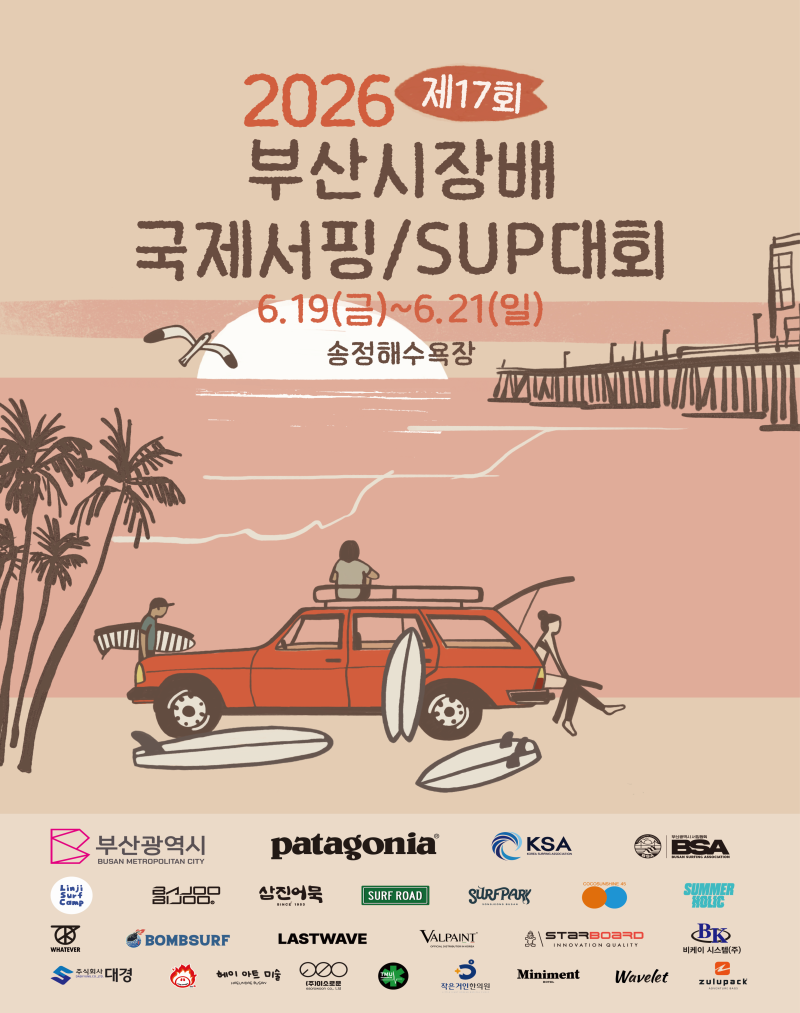
SUP riders use a paddle to catch waves, shortboarders turn sharply on compact boards, and longboarders create smooth lines on longer boards. Each discipline reads the same sea differently. The 2026 17th Busan Mayor's Cup International Surfing & SUP Competition brought those distinct styles together at Songjeong Beach.
The main competition dates were 20–21 June. Hosted by Busan Metropolitan City and organised by the Busan Surfing Association, the event was planned for around 350 domestic and international athletes and enthusiasts. Its programme and judging format offer a useful introduction to surfing and SUP at Songjeong.
Seventeen editions at Songjeong
The Busan Mayor's Cup International Surfing Competition has been part of the city's marine sports calendar since 2009. Drawing on Songjeong's year-round surfing conditions, it brings athletes, recreational riders and beach visitors together.
The 2026 programme comprised 23 events across 13 divisions, including open, beginner, youth and junior categories. Riders with different levels of wave experience could compete in an appropriate division.
Beyond any single contest, this is a Songjeong ocean sports festival where surfing and SUP meet.
SUP catches waves too
The SUP discipline at this event was SUP surfing: standing on a board, using a paddle for propulsion and riding a wave. It rewards different skills from a race over a set distance. Watch how riders catch the wave and develop the ride that follows.
Shortboard surfing highlights agile turns and technical execution; longboarding offers flowing movements and smooth lines on a longer board. In SUP surfing, also watch how the paddle helps the rider enter the wave and control the board.
Speed alone does not decide the result. Wave selection and the quality of what a rider delivers on that wave matter.
- Shortboard
- Agile turns and precise technical execution
- Longboard
- Flowing movements and smooth lines on a longer board
- SUP surfing
- Using the paddle to catch the wave, control the board and sustain the ride
The two best rides make the score
Athletes ride several waves within an allotted heat. Judges add the scores from their two highest-scoring rides to determine the ranking. Simply catching more waves is not enough: riders need to choose good waves and turn those opportunities into well-executed manoeuvres.
Judging considers difficulty, execution, speed and creativity together. From the beach, follow the full ride—from wave selection to its finish—rather than a single spectacular move. Medals and prize money were provided for the top three in each event.
Watch the best two rides: wave choice, technique, speed and flow all count.
From opening heats to finals and awards
The main programme placed the opening ceremony and preliminary heats on 20 June, followed by finals, awards and closing on 21 June. The poster lists 19–21 June, while the main competition dates were 20–21 June.
Surfing follows the waves. The running order and heat times were planned to remain flexible in response to conditions.
- Saturday, 20 June
- Opening ceremony · Beginner and open preliminary heats
- Sunday, 21 June
- Semifinals and finals · Youth and junior events · Awards and closing
- Venue
- Songjeong Beach, Busan
- Host · Organiser
- Busan Metropolitan City · Busan Surfing Association
Surf culture beyond the contest
The beach programme included keyring making, face painting and CPR education. Patagonia's Worn Wear repair truck offered a free mobile workshop encouraging people to repair clothing and keep wearing it longer.
The final activity was a beach clean-up, with participants collecting litter together. Linking time in the waves with care for the sea, the programme reflected surf culture beyond the competition itself.
Carry the feeling of a good session into a cleaner beach. The final programme brought participants together for a beach clean-up.