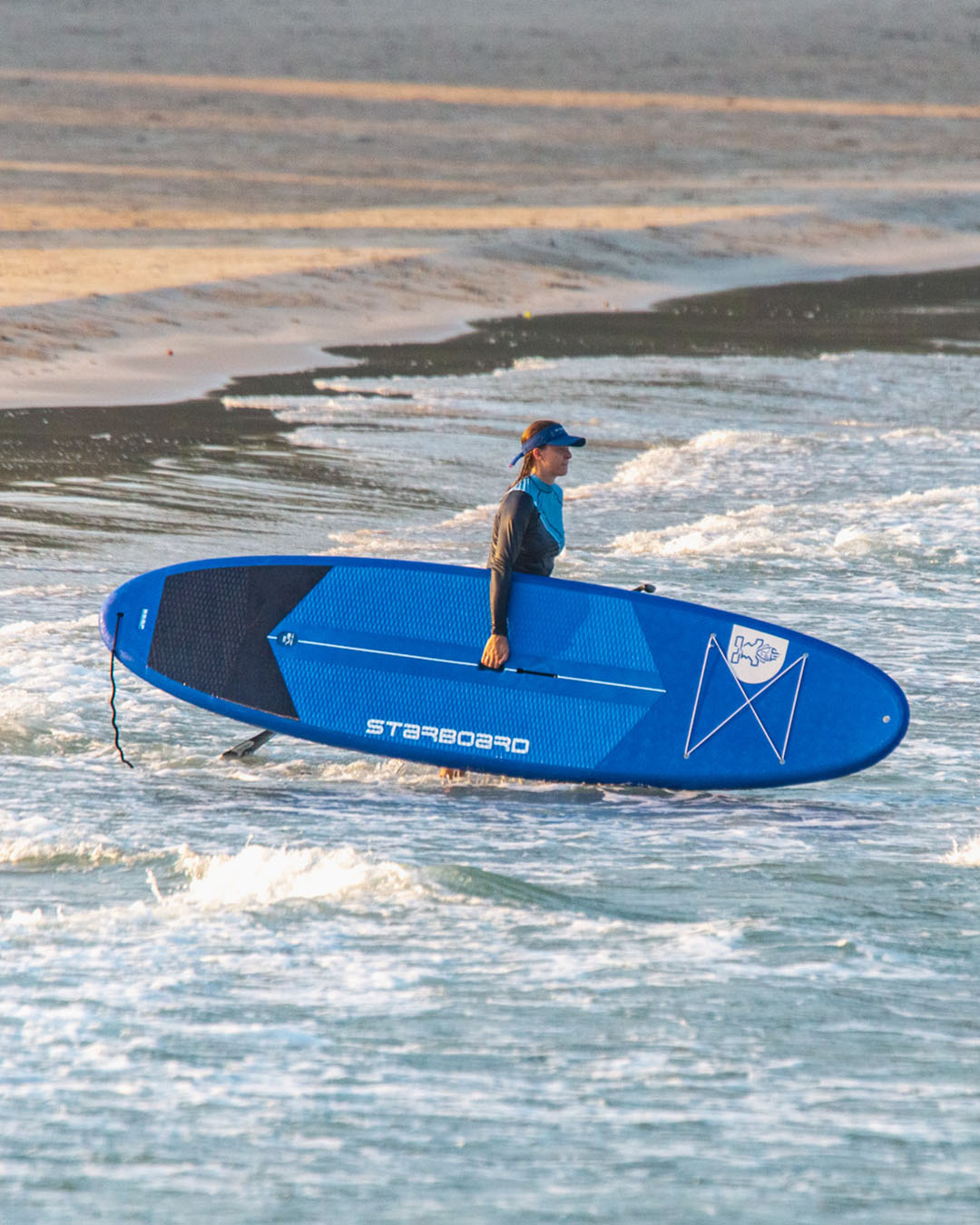
All-round
Explore this style- Power source
- Paddle strokes
- How you start
- Find balance kneeling, then progress to standing
- Where to ride
- Managed, sheltered water with light wind and little current

FIND YOUR RIDE · SUP
From a relaxed paddle to a wave or a race. Four different ways to enjoy one paddle.
Compare at a glance ↓
THE BIG PICTURE
A gentle paddle beside the beach, a race around a buoy, a turn across the face of a wave: these are all moments in SUP. Short for stand-up paddleboarding, SUP uses a paddle to move a board across the water. Where you ride, your pace and what you want from the session shape the experience.
You do not need to choose a discipline on day one. Start by learning balance and board control on calm water. Touring gives that foundation a destination; racing gives it a pace to work towards. If waves catch your imagination, SUP surfing opens another direction to explore.
Picture the day you want: a relaxed paddle, a journey, a faster pace or a session in the waves. That is a useful starting point for choosing a board. One board may suit more than one style, but its shape and size also need to work with your weight and experience.

 01 / 04
EASY DAYS
An easy day on the water
All-round SUP leaves room to enjoy the paddle without rushing towards a destination. The shoreline looks different from a board, and every stroke gives you a feel for how it moves. It suits a short outing with friends or family, or a day when exercise and a little time to unwind belong together.
For a beginner, it is also where the fundamentals take shape: finding your balance, turning when you want to and returning to your starting point. Distance can wait. Being able to control the board is a more useful measure of progress in those first sessions.
Make a confident return your first goal. A short stretch of water is enough to practise straight paddling and turns until the board feels more familiar.
02 / 04EXPLORE FURTHER
A journey powered by your paddle
Touring adds a sense of journey to paddling. Follow the edge of a lake or take in a stretch of coastline, moving into the next view one stroke at a time. The pleasure comes from finding a steady rhythm and seeing where it takes you.
As your outings grow longer, reading the route matters as much as handling the board. Think about where you will launch and return, where you can turn back and how a change in wind could affect the paddle. A short out-and-back route is a worthwhile first tour.
A good tour includes an enjoyable return. Build experience with short outings on familiar water before extending the route.
03 / 04PACE & PROGRESS
Turn each stroke into progress
Racing lets you see the effect of a paddle stroke in the clock. Even on the same course, the start, paddle entry and line around a buoy can change the rhythm of a run. Efficient strokes and a pace you can sustain matter alongside speed.
Entering an event does not have to be the first goal. Time yourself over a short, familiar course and notice whether a turn felt smoother than last time. That gives practice a purpose while you build the balance and control needed for more distance and pace.
A narrower race board is not automatically a better choice. Start with one that lets you focus on paddling instead of spending every stroke trying to stay balanced.
04 / 04FOLLOW THE WAVE
Paddle into a wave. Draw your own line.
On flat water, each paddle stroke moves the board forward. In SUP surfing, a wave carries the ride. You paddle to catch it, then use your balance and board control to follow its face. It brings paddling and reading waves into the same session.
Standing comfortably on calm water is only part of the preparation. Wave choice, entry timing and space around other surfers all take practice. After learning basic board control, lessons in small waves provide a way to build those skills step by step.
Reading waves and leaving room for others are part of surfing well. Look for space to leave the ride as well as an opportunity to catch it.
YOUR NEXT STEP
Once a riding style catches your eye, explore the equipment and the skills to get started.