1 / 2 · What to observe before you go in

2 / 2 · The parallel surf stance

Surfing starts before you stand up on the board. You need time to watch where the waves break and how people are moving. Let's look at Sean Poynter's two pictures, one on observing and one on stance.
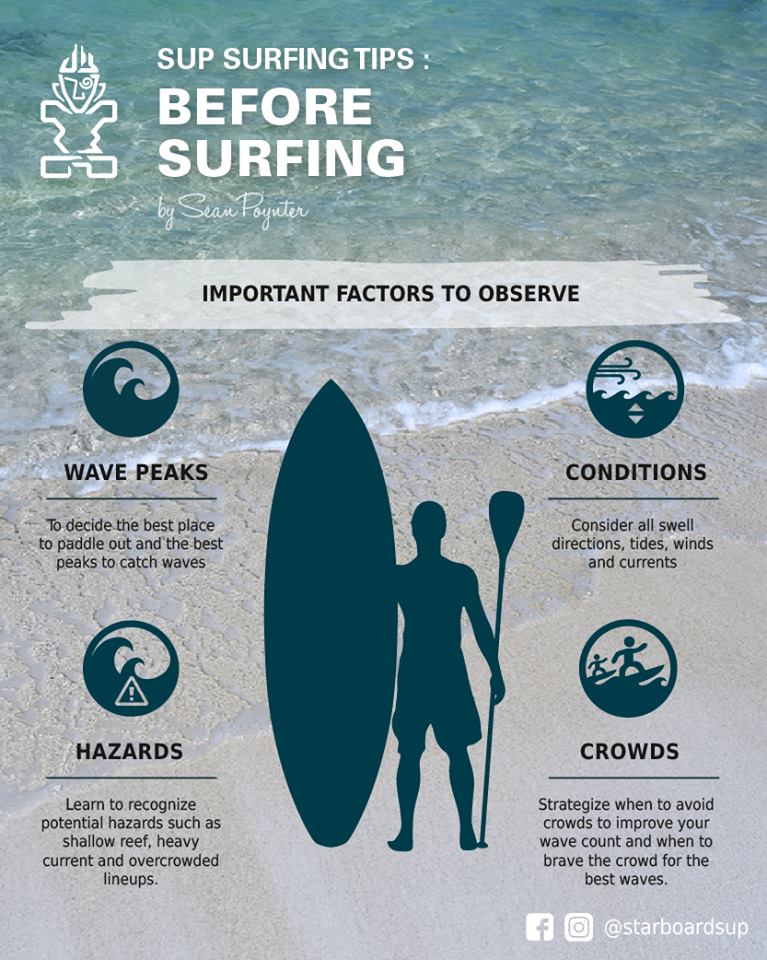
01. Don't just watch the waves; look at what's around them
The first picture breaks things down into where the waves break; swell, tide, wind and currents; hazards; and how crowded it is. You also need to look at your way in and out, shallow reefs and strong currents.
Don't push yourself with the goal of catching good waves in a crowded spot. Learning the local rules and right of way, and choosing conditions that match your skill, comes first.
02. See where your feet go in the parallel surf stance
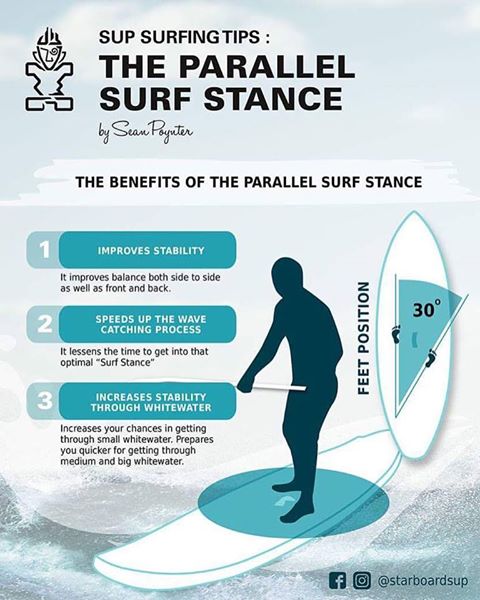
The second picture shows foot placement in the parallel surf stance, with a 30° mark. The original describes its advantages as side-to-side and front-to-back balance and being ready to switch into a surf stance.
This angle isn't forced on everyone as the right answer. Once you understand the diagram in the picture, learn a stance that suits your board and your body with an instructor.
03. Read the whitewater note as a technique tip in context
Whitewater is the water that rolls in as white foam after a wave has broken. The original says this stance helps you get ready to push through it, but that's not permission to go out in big waves.
At first, take plenty of time to learn stopping, turning, falling and getting back on in small conditions. Having both observation and the basics matters more than any one stance in the picture.
Sources and scope
The artwork is Starboard's original infographics of Sean Poynter's pre-surf observation and parallel surf stance; the explanation is Starboard Korea's commentary. We keep the 30° and whitewater notes, but we don't read them as the best angle for every rider or as conditions under which it's OK to go out in big waves.
- Starboard HQ infographic: infograpics-starboard-sup-sean-poynter.jpg · infograpics-starboard-sup-sean-poynter-surf-stance.jpg ↗
- RNLI SUP safety ↗
The illustration is Starboard's original artwork; the explanation is Starboard Korea's editorial guide, translated into English here. Sources checked: 2026-09-08.