
Thor Heyerdahl and the Kon Tiki story
Read the words in the picture
Thor Heyerdahl and the Kon Tiki story
- Lesson Two · SUP Adventures
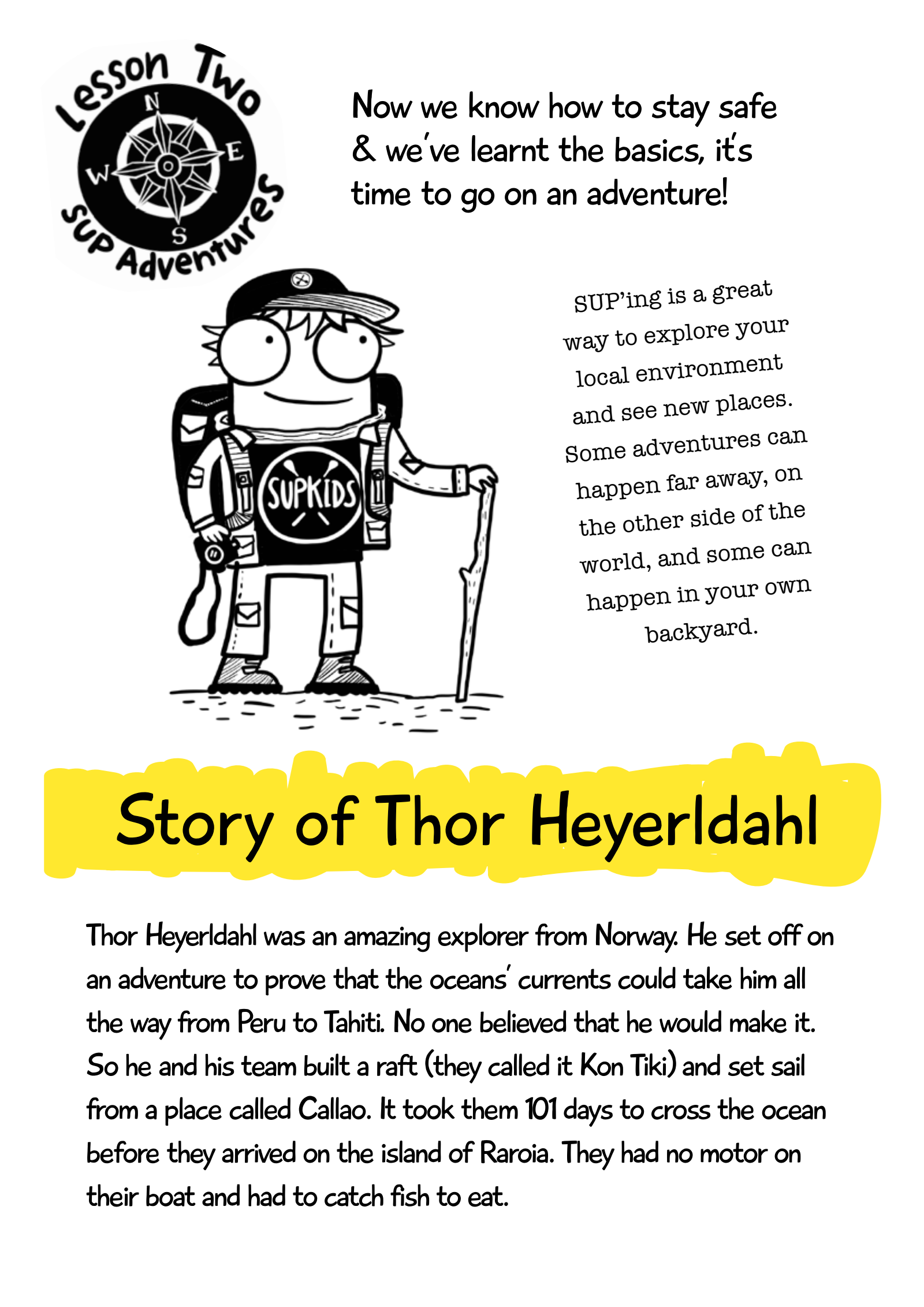
- Now we know how to stay safe & we've learnt the basics, it's time to go on an adventure!
- SUP'ing is a great way to explore your local environment and see new places. Some adventures can happen far away, on the other side of the world, and some can happen in your own backyard.
- Story of Thor Heyerldahl
- Thor Heyerldahl was an amazing explorer from Norway. He set off on an adventure to prove that the oceans' currents could take him all the way from Peru to Tahiti. No one believed that he would make it. So he and his team built a raft (they called it Kon Tiki) and set sail from a place called Callao. It took them 101 days to cross the ocean before they arrived on the island of Raroia. They had no motor on their boat and had to catch fish to eat.
Find teamwork on a raft that sailed far away
In the middle of a huge ocean floats a raft with no motor. Its name is Kon Tiki. The SUPKids workbook tells the story of Thor Heyerdahl, an explorer from Norway, and his team, who crossed the Pacific Ocean on this raft. It was a very different trip from racing along a set route on a fast boat.
The workbook says Heyerdahl wanted to find out whether ocean currents could carry a raft from South America to the islands of the Pacific. The team built a raft and set out from Callao in Peru. The workbook says they crossed the ocean for 101 days and then arrived on the island of Raroia. As we read about the voyage here, we'll pay attention to where it started, how they traveled and the people who went together.
You don't have to cross a faraway ocean like Kon Tiki to be an explorer. Next to this story, the workbook says that discovering the world around you on a SUP is an adventure too. What links a big voyage to exploring the water nearby may not be how far you go. It may be staying curious, looking closely and getting ready together.
Into the story
Look at the start and the finish side by side
Read the names of where they left from and where they arrived, side by side. Callao is the starting point in Peru, in South America. Raroia is the island they reached at the end of the voyage. The workbook first describes the plan to sail toward Tahiti, and then names the place they actually arrived. If you read the goal of the plan separately from the result recorded after the trip, you can understand the story more exactly.
Think about what moved the raft
Kon Tiki tried to travel without a motor, using the flow of the ocean. Imagine the raft the team built floating on the sea. How is it different from a boat with an engine? Remember that it wasn't a trip where they could change direction and speed whenever they wanted. Then staying at sea for a long time may feel different to you.
Read the words 'he and his team' again
The story's main character has one name, but it was a team that built the raft and sailed it. The workbook also says they caught fish at sea to eat. To live at sea for a long time, they probably had to get ready together and help each other. Think about what feelings the people who built the raft and sailed together might have needed. Then talk about the jobs your family could share when getting ready for an adventure.
Connect it to our own small adventures
Along with the voyage story, the workbook also shows a lesson game where several SUP boards are held together to make a raft. Holding the boards together can remind you of teamwork, too. Read this game as an example of an on-water lesson set up by a coach. As a family, you can turn it into writing 'places we want to discover together' and 'ways we can help each other' on paper. It's an activity your family can try together after reading the Kon Tiki story. Listen to what each person hopes to discover when they think about an adventure.
Let’s talk
What do you think?
- If you called the Kon Tiki voyage an adventure someone took alone, what part of the story would be missing?
- On your family's nearby adventure, how could you help each other get ready?
Where the pictures and activities come from
SUPKids workbook p. 16 ↗ · p. 17 ↗
The pictures are pages from the original workbook. The steps and questions below are Starboard Korea’s notes to help families use them together.
Save the original workbook ↓